How much do artists earn?

I’m not netting $50K right now, but in past years, I have earned in that vicinity. I earned the most right before my third child was born, and–if you adjust for inflation–my gross was around $180K, with maybe 3/4 of that being net income.

The bulk of my income came from three sources:

Original art

The largest part of my income came from my original work. I sold through galleries and art associations. I made the most at art association shows, especially one-day outdoor shows. My second best art association outlet was selling through banks; a local bank accepted our art (through the art assoc) for their lobby walls, and my most expensive pieces ($500+ in early 1980s) sold there. Art associations also take a lower commission than many commercial art galleries.

Writing articles & books

My second highest–and most consistent–income was from writing. I wrote & wrote & wrote… mostly how-to articles for magazines, for book publishers, for anyone who would buy. I found my markets through the annual guide, “Writers Markets.” (Always get the latest edition. Your library probably has a copy.)

I sold first rights and then reprints, and the money added up. Those twice-yearly royalty checks from books are nice!

A little here, a little there…

I also made money in peripheral ways… doing custom illustration for printers, doing graphics for convention brochures, zines, and so on. I was always finding new outlets for my creativity, and it paid off in word-of-mouth referrals. I placed no paid advertising for my art, anywhere.

Working at home

In those days, I did no teaching at all. I’m painfully shy (really) and even one-day outdoor art shows were excruciating. So, almost all of my work was done at home, with two toddlers underfoot, and I provided the sole financial support of my family.

Then I remarried, had a third (wonderful) child, and my career seemed to threaten my new husband.

20 years later, I divorced and began the rebuilding process. So far, so good!

Back on track

I have been very successful in the past, working almost entirely from home. I expect to continue in that mode.

The “starving artist” cliche isn’t your only option if you want to earn your living as a full-time artist. No two artists will follow the same path. Find what works for you.

Remember that the average toddler falls down over 300 times before learning to walk. If you try career options that result in dead ends, don’t give up. Hope that it doesn’t take you 300 tries to find your best career path, but don’t give up!
Nevermore – Free Gothic Artist Trading Card

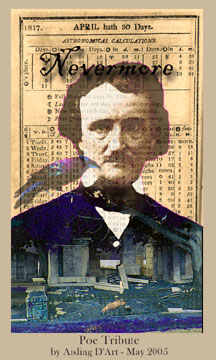
edgar Allan poe ATC by Aisling D'Art

This is from my 2005 series of daily, one-hour artist trading cards, also called ATCs.

In 2005, these were an alternative to “morning pages,” an affirming art journaling process based on Julia Cameron’s The Artists Way.

Artist’s notes from 2005…

For some reason, I was in an Edgar Allan Poe mood this morning.

When I was little, the very first TV show that I can recall seeing was “The Fall of the House of Usher” on PBS, a dramatization of the Edgar Allan Poe story.

(I must have been about four years old at the time. I’m sure that it made an impression that is today reflected in my love of gothic art.)

The background is a page from a copy of the 1817 Farmer’s Almanac that I own.

Next, I added a public domain image of Edgar Allan Poe, found online and altered to suit this card. (See my Resources list, below.)

I used this image in my Edgar Allan Poe Shrine several years ago. The raven on his shoulder is from that shrine as well.

Over his torso, I placed an image from a New Orleans cemetery. When I first saw this falling-apart grave, I thought of the Poe tale. As I made this art card, adding this Poe-like image seemed like a logical step. Of course, I changed the Hue and increased the Saturation; the latter by about 90%.

My exact Photoshop process:

  • Using Photoshop with my desktop computer, I selected Poe’s torso with the rectangular/select area tool, and made a copy of it.
  • I pasted that to a different window and removed the background.
  • Then I increased the contrast of the clothing so that it was sharply black and white.
  • Next I selected the black areas (magic wand tool) and copied them.
  • I pasted them as another layer, over the existing Poe clothing.
  • With the selected areas still outlined, I switched layers so that I was working with the cemetery image.
  • I inverted the selection and cut out (removed) areas of the picture that covered white portions of Poe’s clothing.
  • Then, I flattened the image.
  • Finally, I added the word, “Nevermore,” from Edgar Allan Poe’s “The Raven,” and added a drop shadow to the text.

The finished image is 3″ x 5″ (at 150 dpi) but you can print it at a smaller size.

How to print this Edgar Allan Poe artist trading card

Right-click on this artist trading card link and save the image to your hard drive. Then, print it at 150 dpi if you’d like it in the original 3″ x 5″ size.

(When artists were trading art cards in Red Dog Scott’s swaps, the requested size was usually 3″ x 5″. That’s why this is larger.)

Or, in your printer settings, you can print the card in the more standard ATC size of 2.5″ x 3.5″ and improve the resolution as well.

This finished art is copyrighted, but you can print it freely for your personal use, as long as you don’t alter the design of the card.

RESOURCES