Would you like a free Halloween coloring page? Click the image to download and print it. (The actual page is 8.5″ x 11″)
(For personal use only)
More Free Art and Downloads!
Also at this website, you’ll find many Halloween and ghost-themed art ideas, and a few freebies.
Some are a bit dark and/or ghoulish. (In my semi-Goth teen years, I was a major fan of Edgar Allan Poe. Today…? Not so much, but some artists may appreciate these articles – and art – from many years ago, and still online.)
There are many ways to use rubbings in art journaling, collages, and more.
The shrine example, below, was for a Halloween-themed workshop.
While this illustration may seem too eerie, the concept remains the same, whether you’re doing rubbings of architectural textures, manhole covers in streets, or embellishments on your car.
Nevermore – An altered book for Halloween. Theme: Edgar Allan Poe.
Start with textures
You can use rubbings in your journals and scrapbooks. When you travel, rubbings are a great way to preserve visual details from your trips.
Try rubbing:
Brass plaques and historical markers (make sure that’s permitted, of course)
Texturing on benches
Braille plaques in many public buildings
Chair backs
Cobblestones
Coins and tokens
Doorknobs and related hardware – remember to rub your hotel room key if it’s not a card
Floor or sidewalk art – particularly brass art/plaques embedded in some airport walls and floors
Interesting wall texturing – created to reduce noise – in subways and other public settings
Numbers on houses/buildings
Part of a drain cover (manhole cover)
Raised designs on walls
Seat number tags, if you go to the theatre, ballet or opera
Textured wallpaper, ceilings, and door & window trim
Many food packages have an embossed quality, especially tins.
Some rubbing basics
You’ll need thin paper. Everyday printer paper is fine. Tracing paper can be a little fragile, but it’s ideal for delicate details.
You’ll need something to rub pigment onto the paper. That can be anything from chalk to charcoal, crayons to oil pastels, colored pencil, or even foil or carbon paper.
To prevent damage to the underlying surface, start with a very light stroke. Increase as needed.
Once you’ve completed your rubbing, you may need to protect it from smudging, at least until you get home. Page protectors – the kind sold as office supplies – can be ideal, but use one per rubbing. Hard plastic storage boxes (you can find thin ones at some crafts stores like Michael’s) are useful, too.
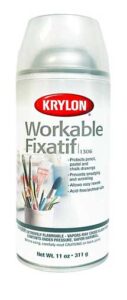
When you arrive at home, if your rubbing is easily smudged, I recommend using a spray fixative according to product instructions.
But, in general, rubbings are best displayed where people won’t be tempted to touch or rub them with their fingers.
For art journaling, you may want to insert or overlay a clear sheet of plastic (perhaps cut from a page protector) or at least a sheet of wax paper, to protect the rubbing.
More ideas
Going to the beach? With very thin paper and soft chalk pastels, you can do a rubbing of the texture that remains in the sand after the tide goes out.
Note: Chalk pastels are easier to handle and can capture more textures than oil pastels. However, the latter are more durable if you’re traveling and your rubbings might get smudged.
Using different colors, you can overlap the wavy lines by moving the paper.
(The paper will be fragile when it’s wet, so handle very carefully. If the sand is moist, you can put plastic wrap or a cheap plastic poncho between the sand and your paper.)
This is from my 2005 series of daily, one-hour artist trading cards, also called ATCs.
In 2005, these were an alternative to “morning pages,” an affirming art journaling process based on Julia Cameron’s The Artists Way.
Artist’s notes from 2005…
For some reason, I was in an Edgar Allan Poe mood this morning.
When I was little, the very first TV show that I can recall seeing was “The Fall of the House of Usher” on PBS, a dramatization of the Edgar Allan Poe story.
(I must have been about four years old at the time. I’m sure that it made an impression that is today reflected in my love of gothic art.)
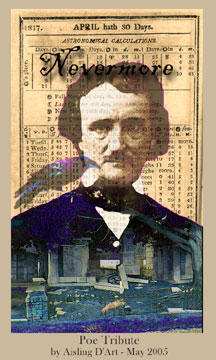
The background is a page from a copy of the 1817 Farmer’s Almanac that I own.
Next, I added a public domain image of Edgar Allan Poe, found online and altered to suit this card. (See my Resources list, below.)
I used this image in my Edgar Allan Poe Shrine several years ago. The raven on his shoulder is from that shrine as well.
Over his torso, I placed an image from a New Orleans cemetery. When I first saw this falling-apart grave, I thought of the Poe tale. As I made this art card, adding this Poe-like image seemed like a logical step. Of course, I changed the Hue and increased the Saturation; the latter by about 90%.
My exact Photoshop process:
Using Photoshop with my desktop computer, I selected Poe’s torso with the rectangular/select area tool, and made a copy of it.
I pasted that to a different window and removed the background.
Then I increased the contrast of the clothing so that it was sharply black and white.
Next I selected the black areas (magic wand tool) and copied them.
I pasted them as another layer, over the existing Poe clothing.
With the selected areas still outlined, I switched layers so that I was working with the cemetery image.
I inverted the selection and cut out (removed) areas of the picture that covered white portions of Poe’s clothing.
Then, I flattened the image.
Finally, I added the word, “Nevermore,” from Edgar Allan Poe’s “The Raven,” and added a drop shadow to the text.
The finished image is 3″ x 5″ (at 150 dpi) but you can print it at a smaller size.
How to print this Edgar Allan Poe artist trading card
Right-click on this artist trading card link and save the image to your hard drive. Then, print it at 150 dpi if you’d like it in the original 3″ x 5″ size.
(When artists were trading art cards in Red Dog Scott’s swaps, the requested size was usually 3″ x 5″. That’s why this is larger.)
Or, in your printer settings, you can print the card in the more standard ATC size of 2.5″ x 3.5″ and improve the resolution as well.
This finished art is copyrighted, but you can print it freely for your personal use, as long as you don’t alter the design of the card.