Fabric arts

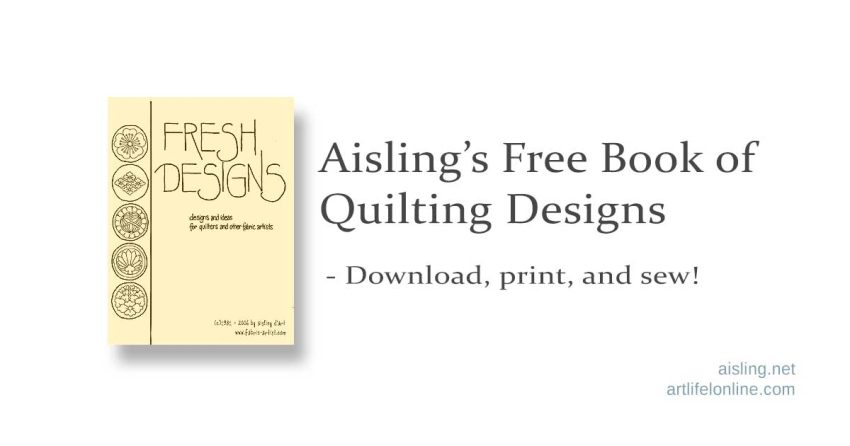
Fresh Designs – free design book

freshdesigns-frontcover-sm

In the early 1980s, I assembled a book of quilting designs. That is, they’re guides for stitching on completed quilts.

However, you could use these same designs for many other kinds of art, especially fabric art. And, I included some suggestions on a couple of pages in this book.

For example: For a non-fabric art application, I might use some of these designs as templates to cut random pages from magazine photos, and create a collage.

In felt or fabric, they could be great applique designs.

In the early 1980s, this book was sold in quilting shops throughout the US, Canada, and Australia.

Now, I’ve scanned the pages of this book, and assembled them as a free book for you to download in PDF format.

How you can use this book and its patterns

You can use these patterns for your own original art, even art that you sell.

You can also copy these pages–or the entire book–and distribute it to friends, or even to students in a class that you teach.

You can use these patterns at your own website, or even offer the book as a freebie at your site.

Copyright

freshdesigns-page2I retain the copyright to this book and its designs. Here are the copyright rules:

You can’t charge for the book or its designs, but it can be a free handout in a class that you teach.

You must be sure that my copyright notice is on any individual pages that you distribute.

Also, don’t pretend that you created this book or its designs.

If you distribute the book–printed or online for printing/download–the last page in the book must be part of it. That’s where the copyright details are.

Please do not link directly to the PDF file at this website. You can link to this page… just not directly to the PDF file itself.

Download as a PDF

freshdesigns-page11smYou can download this book and print it at your computer. It’s in PDF format, which can be read by several programs, including the free Adobe Reader program.

To download your free copy of “Fresh Designs” in PDF format (about 5MB), right-click on this link and choose “Save to Disk.”

(Be sure to remember where you saved it on your hard drive, so that you can print it, later.)

right-click here for Fresh Designs download

(Please do NOT post the PDF link at other websites, forums or lists.)

Baby’s Blocks Gone Wild

boxqIn 1991, I designed and made this quilted wallhanging for a challenge in Salt Lake City, Utah.

A “challenge” is kind of competition.  Usually it includes a rule that all participants must follow.  That rule is designed to make the competition more interesting… or difficult.  In many cases, the challenge element is a particular fabric, batting, or other major element.

In this challenge, I had to use a certain fabric, and it had to appear in at least 20% of the finished quilt.

The challenge fabric was the floral that appears in the Baby’s Blocks section, as well as bordering the top and bottom sections (not the actual border, which is black).

I rarely use muted, tasteful florals in my work.  I struggled to find a way to use the challenge fabric.

Weeks passed and the deadline loomed, and nothing about that fabric inspired me.

Then I realized that I could work in contrasts–meek with wild, traditional with jazzy.

The finished wall hanging is 32″x52″, and at the time I called it, “Threads of the Past, Visions of the Future.” It is pieced and appliqued, with some stenciling (the small yellow dots) as a surface treatment.

This quilt took top marks, winning an award for originality and design.

Today I call it, “Baby’s Blocks, Gone Wild” and I’m eager to do more with contemporary twists and traditional designs.

Baby Quilt – Pink and Red

cromquiltThis is a baby quilt that I made in 2003. It’s made with over a dozen fabrics, each 100% cotton.

Each square in the quilt–and there are hundreds of them–is about 1″ x 1″.

It could be very tedious to make a quilt like this, but the top created with strip piecing.

This is a faster technique that works with strips of fabric, cut after they’re sewn together.

Cutting, sewing, and ironing the top took about six hours, total.

The technique comes from a fabulous book, Strip-Pieced Watercolor Magic: A Faster, New Approach to Creating 30 Watercolor Quilts. The book gives precise directions for selecting fabrics, and how much of each for the 30 projects in the book.

I selected the fabrics using a piece of clear red plastic.

(I bought it years ago. It was designed to help determine light and dark shades without the distraction of colors. I’ve never seen another one of these, but any sheet of clear red plastic or acetate should work fine.)

I modified the design from a pattern for a full-sized bed quilt, to create this small baby quilt for a newborn.

I use blanket-style, needlepunched quilt bats for quilts. They cost a little more, but hold up better in the laundry.

Generally, I tie baby quilts rather than quilting them. Baby quilts are laundered often and the batting starts to fall apart.

With a tied quilt, you can simply undo the yarn or embroidery floss (used to tie it), discard the quilt batting, replace it with a fresh layer, and retie the quilt.

(All of my three children used my handmade quilts when they were little, and I learned to be practical about this.)

Fabric art – where to start?

fabric-green1-illusIf you’re interested in fabric art but don’t know where to start, here are a few basics.

First, decide the kind of fabric art that you’d like to start with.

As time permits, I’ll show you simple projects to “test drive” different forms of fabric art.

For now, here are a few areas to consider:

Cloth dolls and figures

If you’ve always loved dolls, stuffed animals, or art figures, you may enjoy making cloth dolls and figures. You can make them entirely of fabric, or mix different materials, such as a polymer clay face, or wooden chopsticks for legs.

Cloth dolls can be as realistic or stylized as you like. You can make sewing figures or no-sew dolls. Materials can include cloth and stuffing plus needle & thread, or alternative materials.

If you’re a beginner, your doll can be two pieces of fabric sewn, fused, or glued together. If you’re already a fabric artist, the sky’s the limit in terms of materials and techniques.

For a quick view of what others are doing with cloth dolls and mixed media figures, join the Yahoo! Group that I started many years ago, Wild Art Dolls.  Browse through the Files and Photos from its members. You can also ask questions there, and find many helpful tips in the Archives section of that website.

Quilts and wallhangings

Many people start their fabric art careers by making quilts. You can start simply, sewing together squares of fabric.

Or, you can use a commercial pattern–or your own design–for a more unique statement. You can work with traditional designs, or wildly contemporary concepts.

For an overview of your options as a quiltmaker, see these two magazines: Quilters Newsletter magazine, and Quilting Arts magazine.

For mixed media art that includes fabric–a fine way to mix your other favorite techniques and materials with quilting & fabric–see Cloth, Paper, Scissors magazine, from the publishers of Quilting Arts.

I started with traditional quilts in the mid-1970s. At first, I hand-pieced baby quilts for my own infants and friends’. As I became more comfortable with quiltmaking, I made larger quilts with my sewing machine.

Next, I learned “quilt in a day” techniques using strip piecing, and modified these designs to make quilts for shops and galleries.

Finally, I started incorporating fine arts and crafts techniques and mixed media approaches to art quilts and wallhangings. That’s what I’m working on again, now.

Cloth jewelry and accessories

Many people enjoy making fabric jewelry, such as cloth beads, bracelets and cuffs, and necklaces. These are a fine starting point for beginners.

Also, you may enjoy making fabric art accessories for your wardrobe and as gifts for others. These can include belts and sashes, purses, hats, and more.

Lois Ericson is one of the most respected voices in fabric art accessories. Her books and patterns allow considerable flexibility for beginners as well as experienced fabric artists.

Your public library probably has at least one of her books, or can order one on inter-library loan. Highly recommended!

Wearable art – clothing

Pieced and/or embellished garments are among the most fabulous and complex fabric art projects. Belle Armoire magazine is very popular among paper and mixed media artists making the transition to wearables.

You can explore even more wearable art ideas in Fiberarts Magazines’ annual Art-to-Wear issue, Surface Design Journal, and other sewing and beading magazines.

Special issues of Threads, Ornament, and Quilters Newsletter magazines also feature wearable art and related topics.

Where to start…?

My best advice is to start with whichever area seems most exciting to you. There are simple and complex approaches to every kind of fabric art.

Pick one and get started today. You’ll soon find a niche whether you’re a beginner or an experienced tailor/designer/artist.

Delve in and have fun!

Cotton v. Polyester fabrics

fabric-illus1Before rushing out to buy supplies for your fabric art projects, consider a these important points.

Many fabric artists (including me) prefer 100% cotton for most
projects. The benefits are clear:

    Cottons are durable. They don’t “pill” or develop small little fiber balls on the surface.Cottons tear on a straight line. This saves tedious cutting. Clip at the start of where you’d like to tear the fabric, and then start ripping it. 100% cottons tear straight across the fabric. The better the grade of cotton, the cleaner the line.

    Stains are easier to remove from cottons, partly because of the fiber, but also because you can safely launder cotton in very hot water. And, you can bleach white cottons; you should not use chlorine bleach on most polyester fabrics.

    Colors are richer in many cottons, compared with their polyester counterparts.

    Cotton is cooler in summer and warmer in winter, than polyester fabrics.

But, there are compelling reasons not to use 100% cotton in some cases, too:

    You must preshrink cottons, even if the bolt says that the fabric was preshrunk.Cotton wrinkles. If your wearable art is intricate and difficult to iron, this can be a problem. In fact, if you don’t like ironing or don’t have time for it, your favorite wearables may end up being worn infrequently.

    Cotton can fade. If you accidentally add bleach to a laundry load that included colors, the results can be disastrous. Likewise, if you leave a dark cotton in the sun, it will fade. Finally,
    if you work with black or very dark cottons, use detergents designed for dark fabrics, to prevent fading.

    Some image transfer processes work best on polyester blend fabrics.

In general, I use cottons unless there are compelling reasons to use polyesters.  In practical use, I’d guess that I use polyester fabrics less than 1/10 as often as I use 100% cottons.

On my fabric art shelves, I store the cottons separately from blends and polyster fabrics.   It’s important never to confuse the two.

Choose the best fabric for each project, individually.  The purpose of each project will help you decide whether to use cotton or another fabric for your art.

Creativity quotes

Good behavior is the last refuge of mediocrity. — Henry S. Haskins

Free updates by email

Enter your email address:

Delivered by FeedBurner

EnglishFrenchGermanItalianPortugueseRussianSpanish